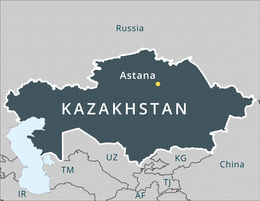
Kazakhstan
In Q1 2026, the economy grew by a mere 3% year on year, largely due to oil production disruptions; however, over the remainder of the year growth is set to pick up more strongly than previously expected. As oil production gradually recovered, output in manufacturing, transportation and storage accelerated to double-digit rates in January-April. Robust investment in these sectors, alongside the state-supported modernisation of utilities, resulted in an overall 6.7% increase in investment in the first four months. By contrast, softening consumer credit growth and still declining real wages (down 2.4% in Q1 year on year) are dampening private consumption. In 2027-2028, growth is likely to pick up to around 5%, driven mostly by domestic demand. Easing inflation will support real wage growth and private consumption, while FDI inflows into recently announced large projects in the chemical, mining and energy sectors will boost investment.
| |
|
|
|
FORECAST* |
| Main Economic Indicators | 2023 | 2024 | 2025 | 2026 | 2027 | 2028 |
| Population, 1000 persons | 19900 | 20159 | 20392 | . | . | . |
| GDP, real change in % | 5.1 | 5.0 | 6.5 | 4.5 | 4.7 | 5.0 |
| GDP per capita (EUR at PPP) | 25530 | 26670 | 28870 | . | . | . |
| Gross industrial production, real change in % | 4.4 | 3.2 | 7.7 | . | . | . |
| Unemployment rate - LFS, in %, average | 4.7 | 4.7 | 4.6 | 4.5 | 4.5 | 4.4 |
| Average gross monthly wages, EUR | 738 | 798 | 751 | . | . | . |
| Consumer prices, % p.a. | 14.5 | 8.7 | 11.4 | 10.0 | 8.0 | 6.0 |
| Fiscal balance in % of GDP | -2.4 | -2.6 | -2.8 | -1.7 | -2.0 | -1.8 |
| Public debt in % of GDP | 24.0 | 24.7 | 24.3 | . | . | . |
| Current account in % of GDP | -3.2 | -2.3 | -4.1 | -0.9 | -3.1 | -4.2 |
| FDI inflow, EUR m | 5294 | 1889 | -810 | . | . | . |
| Gross external debt in % of GDP | 60.8 | 58.6 | 57.1 | . | . | . |
Basic data are continuously updated.
* Forecasts are changed beginning of January, April, July and November.
See Press Conferences.
publication_icon
Monthly Report No. 7-8/2026
Vasily Astrov, Alexandra Bykova, Selena Duraković, Meryem Gökten, Richard Grieveson, Ioannis Gutzianas, Gabor Hunya, Branimir Jovanović, Biljana Jovanovikj, Niko Korpar, Dzmitry Kruk, Isilda Mara, Michał Możdżeń, Emilia Penkova-Pearson, Olga Pindyuk, Sandor Richter, Marko Sošić, Bernd Christoph Ströhm and Marina Tverdostup
wiiw Monthly Report No. 7-8, July-August 2026
52 pages including 5 Tables
Details
publication_icon
Executive summary
Olga Pindyuk
in: The Crisis is Over, but its Scarring Effects are Hindering Recovery
wiiw Forecast Report No. Spring 2024, April 2024 , pp. I-VII
Details
In Q1 2026, the economy grew by a mere 3% year on year, largely due to oil production disruptions; however, over the remainder of the year growth is set to pick up more strongly than previously expected. As oil production gradually recovered, output in manufacturing, transportation and storage accelerated to double-digit rates in January-April. Robust investment in these sectors, alongside the state-supported modernisation of utilities, resulted in an overall 6.7% increase in investment in the first four months. By contrast, softening consumer credit growth and still declining real wages (down 2.4% in Q1 year on year) are dampening private consumption. In 2027-2028, growth is likely to pick up to around 5%, driven mostly by domestic demand. Easing inflation will support real wage growth and private consumption, while FDI inflows into recently announced large projects in the chemical, mining and energy sectors will boost investment.