Global Economy Lecture 2026: How to make the international monetary system more resilient
05 November 2026
Rising US debt, geopolitical fragmentation and financial innovation are putting the international monetary system’s stability at risk. Former IMF Chief Economist Pierre-Olivier Gourinchas outlined how to make it fit for future crises
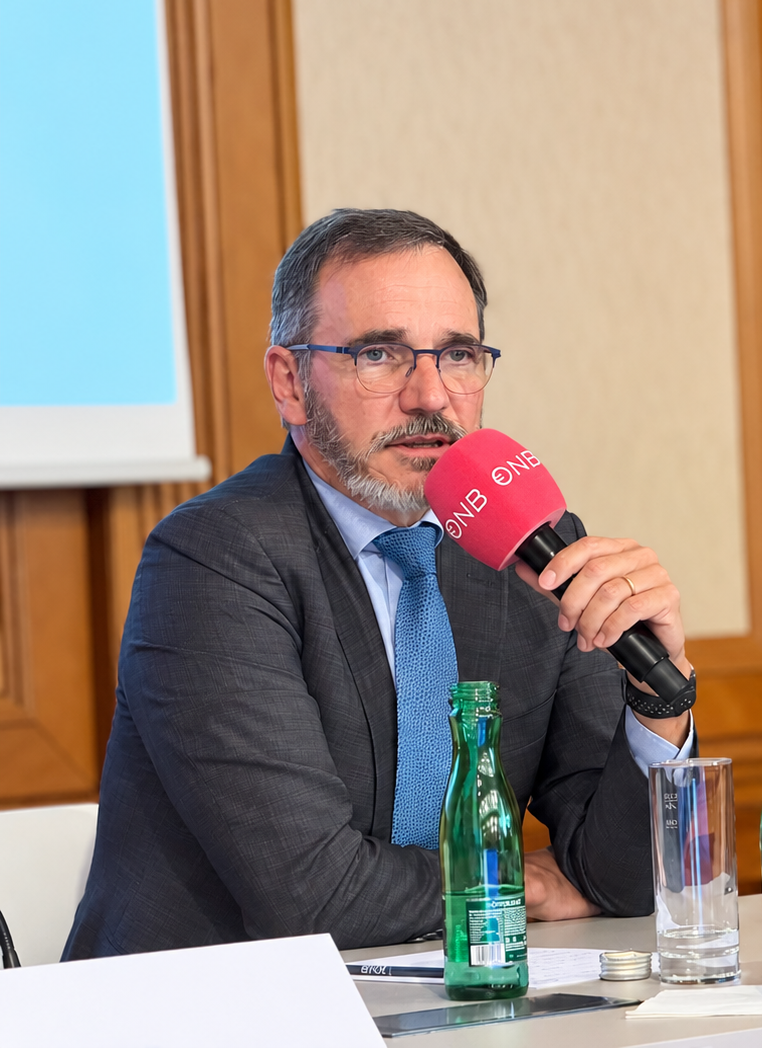
image credit: Oesterreichische Nationalbank
By Florian Huber and Andreas Knapp
The global economic order is undergoing profound changes. China has emerged as a major trading power, geopolitical rivalries are reshaping international trade, and governments are increasingly using trade restrictions and financial sanctions to pursue strategic objectives. Yet one feature has remained remarkably resilient: the dominance of the US dollar in international finance.
These developments were at the heart of the Global Economy Lecture 2026, delivered by Pierre-Olivier Gourinchas, Professor of Economics at the University of California, Berkeley, and former Chief Economist of the International Monetary Fund (IMF), a position he held from 2022 to 2026.
The lecture, entitled The International Monetary System: Current and Future Challenges, took place in Vienna on 28 September 2026 at the Oesterreichische Nationalbank (OeNB), Austria's central bank. The annual event was jointly organised by the Vienna Institute for International Economic Studies (wiiw) and the OeNB.
In his opening remarks, OeNB Governor Martin Kocher highlighted the challenges posed by geopolitical fragmentation, particularly for highly open economies such as Austria. Robert Stehrer, Scientific Director of wiiw, introduced Gourinchas and moderated the discussion.
A multipolar trading world – but a dollar-dominated financial system
One of Gourinchas' central arguments was that global trade and international finance have evolved in strikingly different directions.
Although international trade as a share of global GDP has broadly stagnated since the financial crisis of 2008, there has been no sustained deglobalisation. Instead, the geographical distribution of trade has changed dramatically. China and other emerging economies have become major players, transforming international trade into an increasingly multipolar system.
International finance tells a different story. Despite China's growing economic importance, global financial flows remain heavily concentrated in advanced economies, particularly the United States. The dollar continues to dominate foreign exchange reserves, international bond issuance, cross-border banking and foreign exchange transactions. The euro remains the second most important international currency in several areas, while China's renminbi still plays a comparatively limited role.
China has thus become a global trading power but remains relatively peripheral to international financial markets. The United States, by contrast, occupies a far more prominent position in global finance than its share of international trade would suggest.
Is the international monetary system inherently unstable?
To address this question, Gourinchas revisited two competing perspectives associated with economists Charles Kindleberger and Robert Triffin.
Kindleberger's view sees the United States as the world's banker. It supplies safe, liquid assets to international investors while investing in riskier, higher-yielding assets abroad. During global crises, the US absorbs financial losses, effectively providing insurance to the rest of the world. From this perspective, the dollar-centred system can remain stable.
Triffin's perspective, by contrast, highlights an inherent instability. As the global economy expands, demand for safe dollar assets grows. The US must supply these assets without undermining confidence in its ability to honour its obligations. Eventually, it could become too small relative to the global economy to satisfy this demand, which would destabilise the system.
Gourinchas argued that neither theory fully explains recent developments. The US net international investment position deteriorated to approximately minus 83% of GDP by the end of 2024, meaning that the United States owes the rest of the world substantially more than the rest of the world owes the United States.
This challenges Kindleberger's idea of the US as the world’s banker. However, much of this deterioration reflects the extraordinary performance of US equity markets. Meanwhile, America's share of global GDP has remained relatively stable at around 25%, contradicting a central assumption of the modern Triffin argument.
Gourinchas therefore suggested that the greatest danger may come from the United States itself: unsustainable economic policies - in particular its soaring public debt – could undermine confidence in the foundations of its financial dominance.
Rising US debt and geopolitical fragmentation
He identified three major challenges to the international monetary system: the rising public debt in the US, geoeconomic fragmentation and new financial technologies.
US government debt is particularly concerning. According to Congressional Budget Office projections presented during the lecture, federal debt held by the public stood at approximately 99% of GDP in 2026 and was projected to rise substantially in the years to come. Without significant fiscal consolidation and smaller budget deficits, this trajectory would become unsustainable over the coming decades.
Another major challenge is the fragmentation of global trade along geopolitical lines. Gourinchas presented research showing that political differences between countries have become an increasingly important determinant of bilateral trade.
His findings suggest that fragmentation between Western-aligned and China-aligned countries is progressing at a pace comparable to, or even faster than, the division of international commerce during the early Cold War. Rather than disappearing, trade is increasingly being redirected towards politically aligned partners, creating a few big trading blocs that dominate the world economy.
New financial technologies could create additional vulnerabilities. Gourinchas highlighted dollar-denominated stablecoins, which could face liquidity problems if investors suddenly demanded redemption during a financial crisis.
A stronger financial safety net for vulnerable economies
Despite these risks, Gourinchas concluded with a proposal to make the international monetary system more resilient and explained the limitations of the current framework.
Countries currently rely on foreign exchange reserves, IMF lending facilities, regional financing arrangements and central bank swap lines to protect themselves against external shocks. However, this global financial safety net is unevenly distributed, leaving many emerging markets and low-income countries vulnerable.
Accumulating additional foreign exchange reserves is costly because funds invested in low-yielding safe assets cannot be used for productive investments in infrastructure, education or healthcare.
Gourinchas’ idea of a Synthetic Reserve Deposit (SRD)
Pierre-Olivier Gourinchas therefore proposed an innovative alternative, which he calls a Synthetic Reserve Deposit. Under this arrangement, participating countries would pool part of their foreign exchange reserves in a jointly managed, diversified investment portfolio. The aim would be to generate higher returns while maintaining sufficient liquidity during financial crises.
According to his simulations, a portfolio with a 10% liquidity buffer could have withstood withdrawals during both the global financial crisis and the COVID-19 pandemic without selling longer-term assets. He pointed out that it would take a withdrawal shock roughly three times as large as the one experienced during the 2008 global financial crisis to exhaust the liquidity buffer of his proposed Synthetic Reserve Deposit and break it.
Such an arrangement could make financial protection against crises more affordable, particularly for vulnerable, lower-income economies and make the international monetary system significantly more stable, Gourinchas argued.
China's trade surplus and the role of the euro
During the subsequent discussion, Gourinchas addressed growing economic imbalances between China and the United States. He emphasised that China's expanding goods trade surplus was not simply driven by rising exports. Weak imports also played an important role, reflecting insufficient domestic demand. Although China's current account surplus amounts to only around 3–4% of GDP, the country's enormous economic size makes this imbalance significant for the global economy.
Gourinchas also discussed whether Europe could strengthen the international role of the euro. While growing demand for safe euro-denominated assets presents opportunities, he cautioned against issuing common European debt solely to challenge the dollar. Instead, joint borrowing should finance projects that genuinely require European-level investment, such as defence.