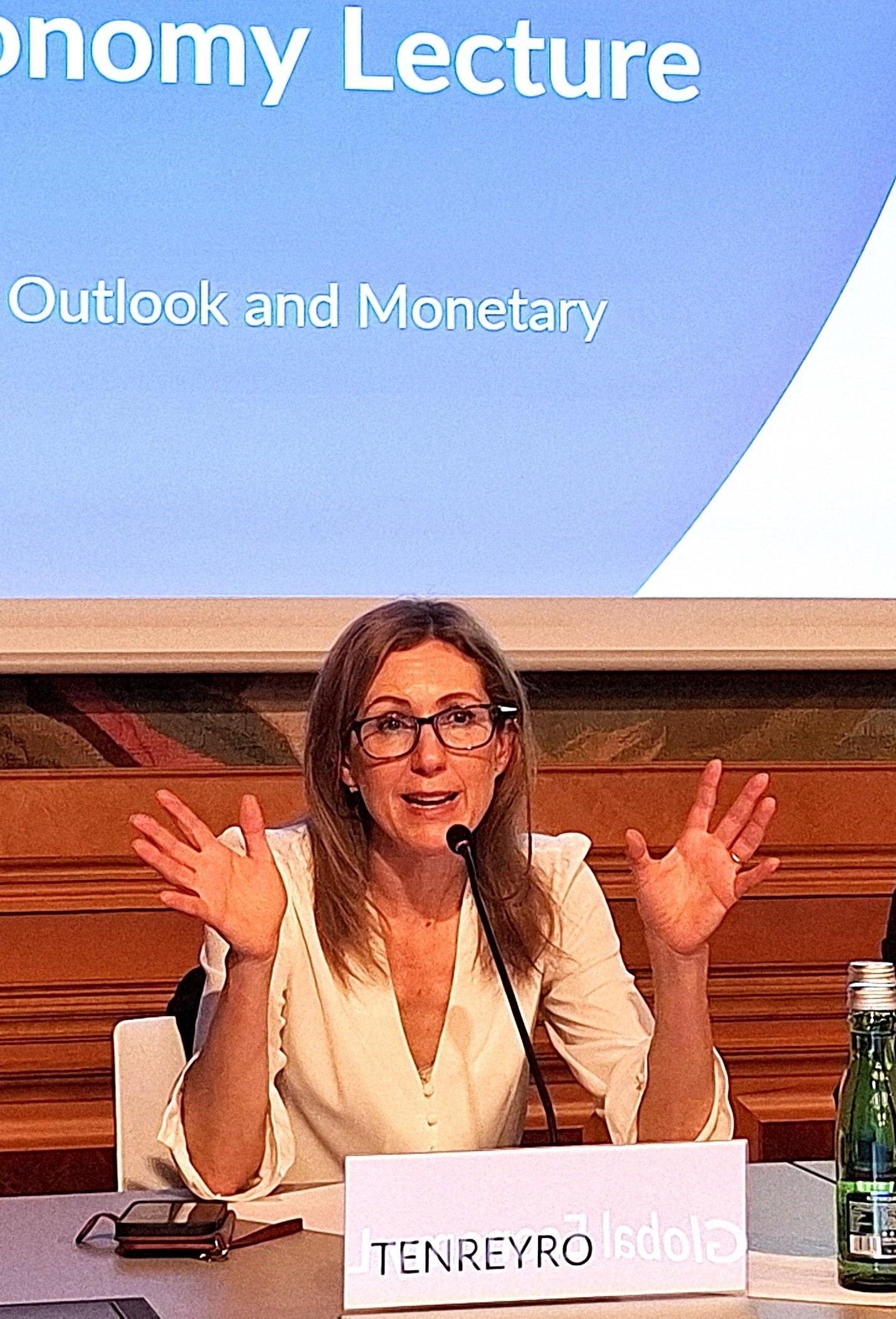
Global Economy Lecture: Silvana Tenreyro on potential responses to economic shocks and the role of negative interest rates
02 December 2025
Negative interest rates can help when there are demand shocks, but they are ineffective during supply shocks. To mitigate the risks associated with future supply stocks, there needs to be technological and trade diversification as well as the creation of resource buffers
image credit: wiiw/Andreas Knapp
The pandemic and subsequent war in Ukraine are current shocks that have had very large impacts on energy and commodities prices and, to some extent, these impacts have been even greater than those experienced during the energy shocks of the 1970s, according to Professor Silvana Tenreyro from the London School of Economics and Political Science. Looking at the US, the euro area and the UK in the aftermath of these negative supply shocks, Prof. Tenreyro notes that, although monetary policy took time to reduce inflation, the effectiveness of the current monetary policy framework is still robust. This was the key takeaway from her Global Economy Lecture delivered at the Austrian National Bank (OeNB) on Wednesday, 5 November, which was jointly organised by the OeNB and the Vienna Institute for International Economics Studies (wiiw). Martin Kocher, Governor of the OeNB, and Robert Stehrer, Scientific Director at wiiw, co-chaired the panel.
After a general overview of the last five years punctuated by several historical comparisons, Prof. Tenreyro delved into the more controversial practice of negative interest rates adopted by certain central banks, which have been criticized by other experts. Prof. Tenreyro pointed to an important distinction between Europe and the US: while the former is mainly an importer of energy and commodities, the latter is a net exporter. As a result, the same supply shocks have hit both regions differently. In addition, while inflation has been driven in the US by strong post-pandemic demand, it has mostly been shock-driven in Europe, meaning caused by higher costs as a result of supply shortages (e.g. energy-price spikes due to the war in Ukraine). The US has generally fared better than both the UK and the euro area since the pandemic thanks to a more generous fiscal stimulus, which in turn has led to higher household incomes than those seen in its counterparts across the Atlantic Ocean. Private consumption has caught up and is now about 15% above its pre-pandemic level in the US, whereas it is trailing behind in the both euro area and the UK.
On top of that, Prof. Tenreyro continued, the impact of recent tariffs is still unclear and their full effect remains to be seen. At least for the time being, the situation will remain ambiguous, although tariffs will definitely diminish global growth. Europe’s economy will weaken due to lower demand for its exports, which are very important to it. At the same time, excess supply of foreign products – first and foremost from China – will most likely reduce inflation in Europe.
In the midst of all the uncertainty caused by the pandemic and the war in Ukraine – in addition to tariffs, climate change and the fact that investments are shifting away from the US dollar (which is less dominant now but will still remain dominant for the foreseeable future) – how might central banks react to future economic shocks? Prof. Tenreyro pointed out that one of the monetary policy instruments that central banks have at their disposal is negative interest rates, which have proven to be quite effective during demand shocks. Simply put, negative interest rates occur when central banks set their policy rate below zero, meaning commercial banks are charged for keeping money with the central banks, which encourages them to lend more to businesses and households, thereby boosting the economy.
This hotly debated policy is opposed by many banks – especially in Germany. Nevertheless, as Prof. Tenreyro explained, aggregate banking-sector profitability is not adversely affected by negative interest rates and may even benefit from them. Furthermore, studies have shown that the effects of negative interest rates on banks are generally benign and that although the effect on the lending rate is rather small and potentially delayed, it is still generally positive and works in the right direction. Only banks that finance themselves heavily with savings from consumers and cooperative banks could see a decline in their profitability, Prof. Tenreyro noted.
In short, in the event of demand shocks, negative interest rates can slightly boost the economy, with the effect being larger in more open economies, where financial markets play a larger role in funding the economy (i.e. market-based finance).
At the same time, Prof. Tenreyro highlighted that monetary policy cannot solve everything. Indeed, supply shocks are much less responsive to monetary policy tools. To reduce the impact of such supply shocks, countries need to formulate realistic strategies built on at least three pillars: technological diversification, trade diversification, and the establishment of strategic reserves in critical raw materials and energy (i.e. buffer building). Together, these measures can make economies less vulnerable to supply disruptions.
Watch the full Global Economy Lecture with Silvana Tenreyro.