Monthly Report No. 06/2026
Javier Flórez Mendoza, Gentian Gashi, Meryem Gökten, Richard Grieveson, Gabor Hunya, Juliane Unger and David Zenz
wiiw Monthly Report No. 06, June 2026
39 pages including 14 Figures
Editorial insight: A decade of political upheaval has fundamentally changed the CESEE economies
by Richard Grieveson
Over the past decade, Central, East and Southeast Europe (CESEE) has been reshaped by an almost continuous sequence of political and geopolitical shocks. What began actually more than a decade ago with Russia’s initial invasion of Ukraine in 2014, and continued with the UK’s vote to leave the EU ten years ago this month, has evolved into a broader reconfiguration of the global economic order – one that is now deeply embedded in the region’s growth model, business environment and long-term prospects.
Chart of the month: The China shock 2.0 arrives in CESEE
by David Zenz
China’s export boom to the CESEE countries is no longer just about consumer goods: increasingly, the new ‘China shock 2.0’ is making itself felt through industrial imports – from machinery and chemicals, to batteries and electric vehicles, in sectors that form the backbone of the region’s growth model. Chinese suppliers are increasingly replacing European ones within Europe’s own supply chain.
Macro snapshot: Labour-market momentum is slowing across EU-CEE
by Gentian Gashi
Labour-market conditions in EU-CEE initially improved following the pandemic, but that momentum has weakened in recent years, with several countries experiencing rising unemployment and declining or stagnant job-vacancy rates. The Beveridge curves highlight a growing heterogeneity across the region: cyclical weakening in Romania, a possible labour-market mismatch in Lithuania and easing of the tight labour market in Hungary.
Focus of the month: Poland among NATO’s biggest defence spenders
by Juliane Unger
Poland has become one of NATO’s biggest defence spenders relative to GDP, approaching 4.8% in 2026. The buildup has so far been financed mainly through the issuance of national debt, with the national escape clause (NEC) providing legal cover since 2025. Additionally, the freshly implemented EU instrument Security Action for Europe (SAFE) provides a new financing tool for the coming years. By targeting domestic value added, it could strengthen both the Polish and the wider European economy.
Research in brief:
- Population ageing costs and required fiscal adjustment in EU-CEE
Client: Dezernat Zukunft
by Meryem Gökten
Population ageing in EU-CEE countries is expected to increase public spending, while at the same time slowing economic growth, creating significant challenges for fiscal policy. However, under the reformed EU fiscal framework, the fiscal adjustment required from governments crucially depends on underlying – and often arbitrary – assumptions about future ageing costs and debt sustainability. - Geoeconomic fragmentation: lessons for Europe and CESEE
Client: Asian Development Bank (ADB)
by Javier Flórez Mendoza
Our simulations show that tariffs used as a geopolitical tool can dramatically rewire global trade patterns. The effects are especially large in the case of the Association of Southeast Asian Nations (ASEAN) and other high-tech hubs, but spillovers are also created for Europe and Central, Eastern and Southeastern Europe (CESEE) through disrupted value chains and higher input costs.
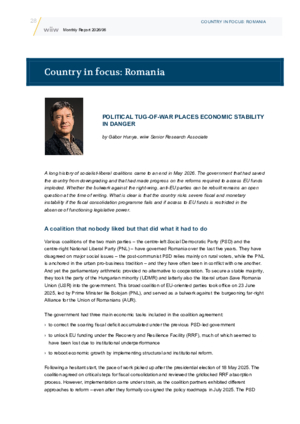
Country in focus: Romania - Political tug-of-war places economic stability in danger
by Gábor Hunya
A long history of socialist-liberal coalitions came to an end in May 2026. The government that had saved the country from downgrading and that had made progress on the reforms required to access EU funds imploded. Whether the bulwark against the right-wing, anti-EU parties can be rebuilt remains an open question at the time of writing. What is clear is that the country risks severe fiscal and monetary instability if the fiscal consolidation programme fails and if access to EU funds is restricted in the absence of functioning legislative power.
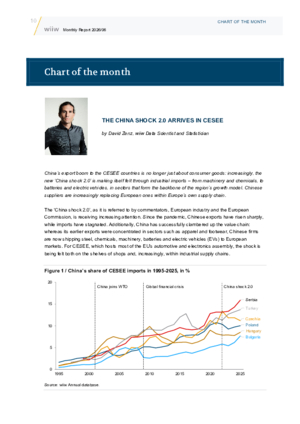
Chart of the month: The China shock 2.0 arrives in CESEE
by David Zenz
free download
Country in focus: Romania - Political tug-of-war places economic stability in danger
by Gabor Hunya
free download
Monthly and quarterly statistics for CESEE
by wiiw statistics department
Reference to wiiw databases: wiiw Annual Database, wiiw Monthly Database
Keywords: growth model, war in Ukraine, Brexit, China shock 2.0, consumer goods, industrial goods, unemployment, job vacancies, Beveridge curve, defence spending, defence production, national escape clause, Security Action for Europe, population ageing, fiscal adjustment, EU fiscal framework, value chains, import tariffs, trade flows, political crisis, fiscal consolidation, EU funds
Countries covered: CESEE, EU-CEE, Europe, Global, Poland, Romania
Research Areas: Macroeconomic Analysis and Policy, Labour, Migration and Income Distribution, International Trade, Competitiveness and FDI, Sectoral studies