Monthly Report No. 03/2026
Vasily Astrov, Meryem Gökten, Richard Grieveson, Ioannis Gutzianas, Nadya Heger, Mario Holzner and Olga Pindyuk
wiiw Monthly Report No. 03, March 2026
31 pages including 1 Table and 5 Figures
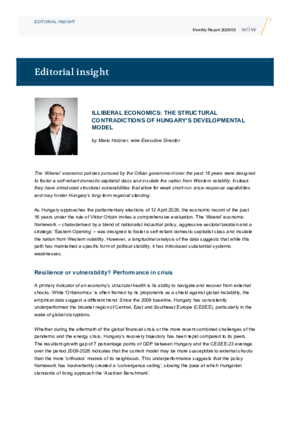
Editorial insight: Illiberal economics - The structural contradictions of Hungary's developmental model
by Mario Holzner
The ‘illiberal’ economic policies pursued by the Orbán government over the past 16 years were designed to foster a self-reliant domestic capitalist class and insulate the nation from Western volatility. Instead, they have introduced structural vulnerabilities that allow for weak short-run crisis-response capabilities and may hinder Hungary’s long-term regional standing.
Chart of the month: Windfall gain to Russia from the war in Iran
by Vasily Astrov
Thanks to skyrocketing global oil prices and the narrowing discount on Russian oil, the war in Iran has provided the Russian government with an expected bonanza. Its size will depend on how long the conflict lasts and how long oil prices stay at their current high level.
Macro snapshot: EU-CEE continues to outperform Germany, thanks to the resilience of domestic demand
by Nadya Heger
With the exception of Romania, all EU-CEE economies outperformed Germany in Q4 2025, suggesting a degree of resilience to global demand fluctuations and unfavourable external conditions.
Focus of the month: What the war in the Middle East means for CESEE
by Richard Grieveson
Despite soaring energy prices and rising risk premia on CESEE sovereign bonds, there is good reason to be cautious about drawing too close a parallel with 2022, when Russia launched its war on Ukraine. Back then, the energy price shock coincided with global supply shortages and pandemic-era fiscal stimulus still working through the system. That combination is not present today.
Research in brief:
- Elimination of remaining trade barriers with the EU could push up Turkish exports by 6%
Client: Austrian Federal Ministry of Economy, Energy and Tourism
by Meryem Gökten
Despite rising trade volumes following the creation of a Customs Union between Turkey and the EU, over the past 15 years the EU and Austria have gradually lost market share in Turkey, while Russia and China have increased theirs. - Pronounced shift in Ukraine’s exports towards the EU and agriculture
by Olga Pindyuk
Russia’s blockade of traditional Black Sea routes has forced Ukrainian exporters to seek alternative markets and logistics channels, while metallurgy – a pre-war cornerstone of Ukraine’s export economy – has suffered a sharp decline due to the destruction of production facilities.
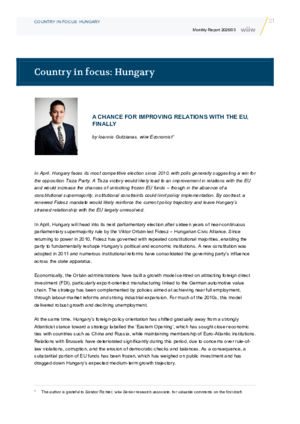
Country in focus: Hungary - A chance for improving relations with the EU, finally
by Ioannis Gutzianas
In April, Hungary faces its most competitive election since 2010, with polls generally suggesting a win for the opposition Tisza Party. A Tisza victory would likely lead to an improvement in relations with the EU and would increase the chances of unlocking frozen EU funds – though in the absence of a constitutional supermajority, institutional constraints could limit policy implementation. By contrast, a renewed Fidesz mandate would likely reinforce the current policy trajectory and leave Hungary’s strained relationship with the EU largely unresolved.
Editorial insight: Illiberal economics: The structural contradictions of Hungary's developmental model
by Mario Holzner
free download
Country in focus: Hungary - A chance for improving relations with the EU, finally
by Ioannis Gutzianas
free download
Monthly and quarterly statistics for CESEE
by wiiw statistics department
Reference to wiiw databases: wiiw Monthly Database
Keywords: illiberal economics, developmental model, oil prices, war in Iran, economic growth, GDP by expenditure, war in Iran, energy prices, supply chains, sovereign bond yields, inflation, GDP, Customs Union, trade liberalisation, geographical composition of trade, commodity structure of trade, parliamentary elections, economic governance, corruption
Countries covered: CESEE, EU, EU-CEE, Russia, Ukraine, US, Hungary, Turkey
Research Areas: Macroeconomic Analysis and Policy, International Trade, Competitiveness and FDI, Sectoral studies