Monthly Report No. 10/2026
Vasily Astrov, Nadya Heger, Philipp Heimberger, Mario Holzner and Branimir Jovanović
wiiw Monthly Report No. 10, October 2026
32 pages including 7 Figures
Current issues accessible exclusively for Members. Free access after an embargo period of three months.
Editorial insight: Germany’s war economy and CESEE: A story more fragile than it would appear
by Mario Holzner
CESEE’s industry does track German defence spending over the long term, but over the short term it derives little benefit from the increases. Arguably, a more compelling issue is that there is a growing global drag on foreign investment amid the geopolitical risks.
Chart of the month: Europe entering winter with historically low gas reserves
by Vasily Astrov
The recent spike in natural gas prices driven by the war in Iran means that the EU is entering the winter with historically low gas reserves. A combination of a cold winter and an early phasing-out of Russian gas deliveries could result in unmet gas demand and/or a further rise in prices, with landlocked CESEE countries being particularly at risk.
Macro snapshot: Investment in EU-CEE gains in importance as consumption moderates
by Nadya Heger
Despite considerable external headwinds, most EU-CEE economies continued to grow at a solid pace in H1 2026. Slovenia, Poland and Lithuania performed particularly well, though Romania remained in recession. Overall, the contribution of private consumption to GDP growth moderated, while investment gathered momentum, thanks in large part to the inflows of EU transfers.
Focus of the month: Higher defence spending in the EU: Fiscal pressures and macroeconomic effects
by Philipp Heimberger
Defence spending in the EU has been rising amidst the war in Ukraine and heightened geopolitical tension with the US. In response, the European Commission has invited member states to activate the national escape clause (NEC), which allows defence spending to be exempted from EU fiscal rules until 2028. However, it is not designed to accommodate a permanent increase in defence spending, for which durable financing solutions remain lacking. We find that increased defence spending will have limited positive growth effects on the EU economy.
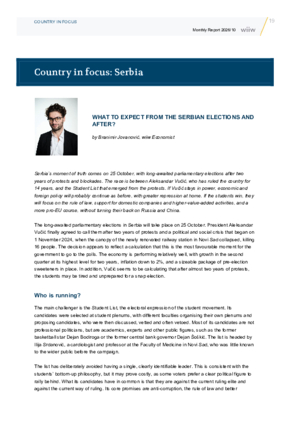
Country in focus: What to expect from the Serbian elections and after?
by Branimir Jovanović
Serbia’s moment of truth comes on 25 October, with long-awaited parliamentary elections after two years of protests and blockades. The race is between Aleksandar Vučić, who has ruled the country for 14 years, and the Student List that emerged from the protests. If Vučić stays in power, economic and foreign policy will probably continue as before, with greater repression at home. If the students win, they will focus on the rule of law, support for domestic companies and higher-value-added activities, and a more pro-EU course, without turning their back on Russia and China.
Country in focus: What to expect from the Serbian elections and after?
by Branimir Jovanović
free download
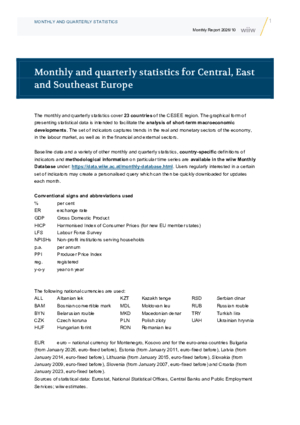
Monthly and quarterly statistics for CESEE
by wiiw statistics department
Reference to wiiw databases: wiiw Annual Database, wiiw Monthly Database
Keywords: defence spending, industrial production, FDI inflows, natural gas prices, underground gas storage, LNG, investment, consumption, GDP growth, national escape clause, fiscal sustainability, parliamentary election, economic policy, foreign policy
Countries covered: CESEE, EU, EU-CEE, Europe, Germany, Serbia
Research Areas: Macroeconomic Analysis and Policy, Sectoral studies