Monthly Report No. 09/2026
Alexandra Bykova, Kristijan Fidanovski, Richard Grieveson, Philipp Heimberger, Mario Holzner, Jelena Jovanović and Olga Pindyuk
wiiw Monthly Report No. 09, September 2026
35 pages including 10 Figures
Current issues accessible exclusively for Members. Free access after an embargo period of three months.
Editorial insight: CESEE’s resilience is no substitute for policy strategy
by Mario Holzner
CESEE’s resilience has bought time, but it is not a strategy. As the old growth model wanes, so the region needs productive investment and EU support to withstand future shocks.
Chart of the month: EU-CEE now has a bigger state, but hasn’t yet worked out how to pay for it
by Richard Grieveson
Government spending has risen sharply across EU-CEE since 2019, reflecting not only higher defence expenditure but a broader expansion of the state’s role in the economy. With much of this increase financed through persistent fiscal deficits, governments now face difficult choices over taxes, spending priorities and how to make the bigger state work more efficiently.
Macro snapshot: Only limited pass-through of the energy price shock to CESEE economies – for now
by Alexandra Bykova
Despite energy price pressures stemming from the conflict in the Middle East, the pass-through to inflation in most CESEE countries has so far remained relatively contained and smaller than in 2022, when Russia attacked Ukraine. However, rising global food prices, escalating geopolitical tensions and the renewed surge in oil prices may push inflation up in the coming months, which could require monetary policy tightening and other policy measures throughout the region.
Focus of the month: Recent trends in global government bond yields - implications for EU-CEE countries
by Olga Pindyuk
Global bonds have been experiencing a sell-off this year, with bond yields growing particularly markedly in the US. In contrast, many EU-CEE countries – like other emerging markets – continue to remain relatively attractive investment destinations and have recorded a slower growth in their bond yields than the US. However, there is a clear divergence of performance within the EU-CEE region, with Romania (and potentially Poland) serving as a cautionary tale about the dangers of imprudent fiscal policies.
Research in brief:
- Economics and quality of life top the list of emigration drivers in EU candidate countries
Client: European Union
by Kristijan Fidanovski
Survey analysis and focus groups reveal that better economic prospects and public services such as healthcare and education drive emigration intentions in the Western Balkans and Eastern Partnership countries, where between a sixth and a quarter of citizens are considering leaving. - Financing a strong EU budget through new revenue sources
Client: Arbeiterkammer Wien
by Philipp Heimberger
Spending needs for the next EU budget for 2028-2034 have increased. The debate should therefore move beyond politically contentious increases in national contributions, which are financed largely through taxes on labour and consumption. This project analyses how new revenue sources, including taxes on crypto transactions, online gambling, financial transactions, aviation and digital services, could help finance a stronger EU budget.
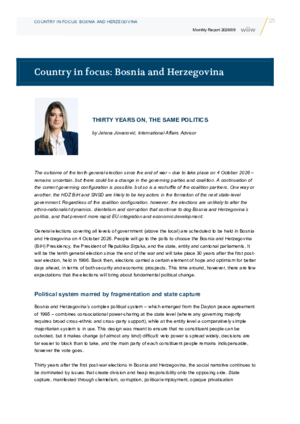
Country in focus: Bosnia and Herzegovina - Thirty years on, the same politics
by Jelena Jovanović
The outcome of the tenth general election since the end of war – due to take place on 4 October 2026 – remains uncertain, but there could be a change in the governing parties and coalition. A continuation of the current governing configuration is possible, but so is a reshuffle of the coalition partners. One way or another, the HDZ BiH and SNSD are likely to be key actors in the formation of the next state-level government. Regardless of the coalition configuration, however, the elections are unlikely to alter the ethno-nationalist dynamics, clientelism and corruption that continue to dog Bosnia and Herzegovina’s politics, and that prevent more rapid EU integration and economic development.
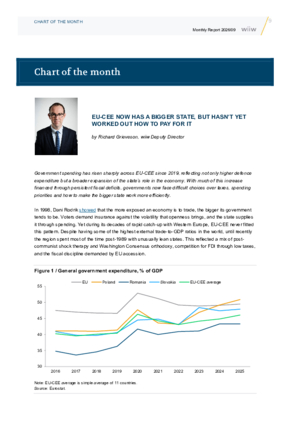
Chart of the month: EU-CEE now has a bigger state, but hasn’t yet worked out how to pay for it
by Richard Grieveson
free download
Country in focus: Bosnia and Herzegovina - Thirty years on, the same politics
by Jelena Jovanović
free download
Monthly and quarterly statistics for CESEE
by wiiw statistics department
Reference to wiiw databases: wiiw Annual Database, wiiw Monthly Database
Keywords: growth model, FDI inflows, EU support, investments, innovation, role of the state in the economy, defence spending, trade openness, budget deficits, war in the Middle East, energy prices, food prices, inflation, bond yields, fiscal policy, risk premia, general election, government coalition, EU integration
Countries covered: Bosnia and Herzegovina, CESEE, EU-CEE, European Union, G7, US
Research Areas: Macroeconomic Analysis and Policy, Labour, Migration and Income Distribution