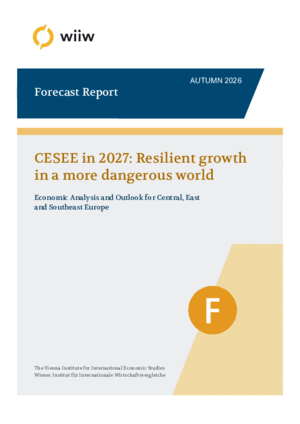
CESEE in 2027: Resilient growth in a more dangerous world
Vasily Astrov, Alexandra Bykova, Selena Duraković, Meryem Gökten, Richard Grieveson, Gabor Hunya, Branimir Jovanović, Biljana Jovanovikj, Jakub Komárek, Niko Korpar, Dzmitry Kruk, Isilda Mara, Michał Możdżeń, Emilia Penkova-Pearson, Emilė Petravičiūtė, Olga Pindyuk, Sandor Richter, Bernd Christoph Ströhm and Marina Tverdostup
wiiw Forecast Report No. Autumn 2026, October 2026
142 pages including 29 Tables and 46 Figures
The current report is only available to members. Past issues become freely available online when the next report is released. Several individual sections of the report are freely available to download now (see below).
Despite a stronger-than-expected recovery in European industry, the euro area faces a difficult outlook, with renewed inflationary pressures, high interest rates and mounting fiscal challenges expected to constrain growth in 2027. Against this backdrop, most economies in Central, East and Southeast Europe (CESEE) remain resilient and continue to outperform Western Europe, although differences between countries are widening. The region's traditional growth model, based on cheap labour, foreign investment and German industrial demand, is giving way to one increasingly driven by domestic demand, automation and investment in defence, energy and higher-value industries, creating new opportunities alongside significant geopolitical and economic risks.
Indicators 2024-2025 and Outlook 2026-2028
Premium Members only
Summary of key recent macroeconomic data for CESEE, and overview of new wiiw forecasts for 2026-2028 (Excel file)
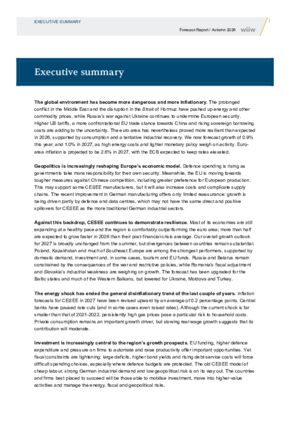
Executive summary
by Richard Grieveson
free download
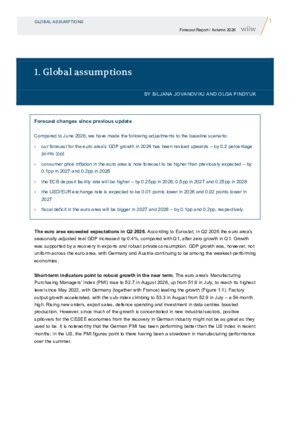
Global assumptions
by Biljana Jovanovikj and Olga Pindyuk
Despite a stronger-than-expected recovery in European industry, the euro area faces a difficult outlook, with GDP growth forecast at just 1% in 2027. The prolonged Middle East conflict and elevated energy prices are pushing up inflation, forcing the ECB to maintain tighter monetary policy for longer and adding to mounting fiscal pressures. Geopolitical instability, rising defence spending and risks to global trade and financial markets will continue to shape Europe's economic prospects.
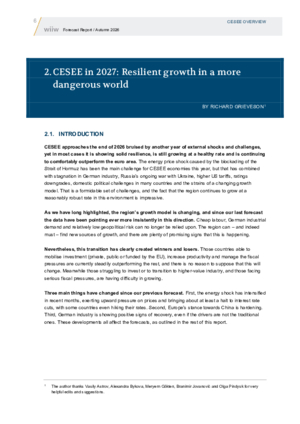
CESEE overview
by Richard Grieveson
Despite renewed geopolitical shocks and higher energy prices, most economies in Central, East and Southeast Europe (CESEE) remain resilient and continue to outperform Western Europe, although the gap between the region’s winners and losers is widening. The region’s traditional growth model, based on cheap labour, foreign investment and German industrial demand, is giving way to one increasingly driven by domestic demand, automation, higher-value manufacturing and investment in defence and energy. Our latest forecasts for 2027–2028 identify where growth opportunities are emerging, and how inflation, fiscal pressures and geopolitical risks could shape the outlook.
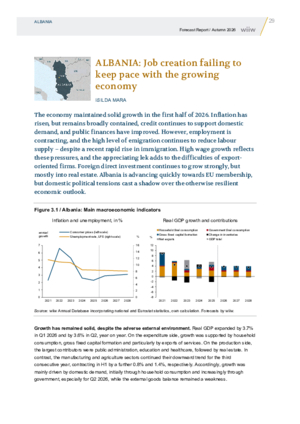
ALBANIA: Job creation failing to keep pace with the growing economy
by Isilda Mara
The economy maintained solid growth in the first half of 2026. Inflation has risen, but remains broadly contained, credit continues to support domestic demand, and public finances have improved. However, employment is contracting, and the high level of emigration continues to reduce labour supply – despite a recent rapid rise in immigration. High wage growth reflects these pressures, and the appreciating lek adds to the difficulties of export-oriented firms. Foreign direct investment continues to grow strongly, but mostly into real estate. Albania is advancing quickly towards EU membership, but domestic political tensions cast a shadow over the otherwise resilient economic outlook.
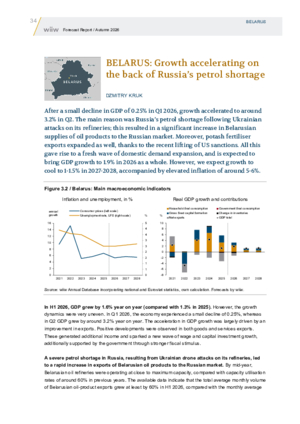
BELARUS: Growth accelerating on the back of Russia’s petrol shortage
by Dzmitry Kruk
After a small decline in GDP of 0.25% in Q1 2026, growth accelerated to around 3.2% in Q2. The main reason was Russia’s petrol shortage following Ukrainian attacks on its refineries; this resulted in a significant increase in Belarusian supplies of oil products to the Russian market. Moreover, potash fertiliser exports expanded as well, thanks to the recent lifting of US sanctions. All this gave rise to a fresh wave of domestic demand expansion, and is expected to bring GDP growth to 1.9% in 2026 as a whole. However, we expect growth to cool to 1-1.5% in 2027-2028, accompanied by elevated inflation of around 5-6%.
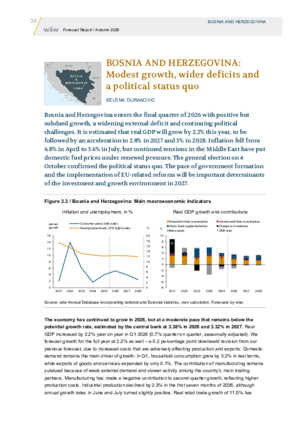
BOSNIA AND HERZEGOVINA: Modest growth, wider deficits and a political status quo
by Selena Duraković
Bosnia and Herzegovina enters the final quarter of 2026 with positive but subdued growth, a widening external deficit and continuing political challenges. It is estimated that real GDP will grow by 2.2% this year, to be followed by an acceleration to 2.8% in 2027 and 3% in 2028. Inflation fell from 6.8% in April to 3.6% in July, but continued tensions in the Middle East have put domestic fuel prices under renewed pressure. The general election on 4 October confirmed the political status quo. The pace of government formation and the implementation of EU-related reforms will be important determinants of the investment and growth environment in 2027.
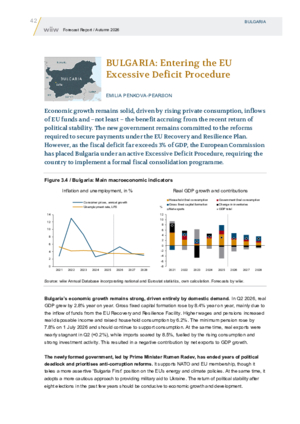
BULGARIA: Entering the EU Excessive Deficit Procedure
by Emilia Penkova-Pearson
Economic growth remains solid, driven by rising private consumption, inflows of EU funds and –not least – the benefit accruing from the recent return of political stability. The new government remains committed to the reforms required to secure payments under the EU Recovery and Resilience Plan. However, as the fiscal deficit far exceeds 3% of GDP, the European Commission has placed Bulgaria under an active Excessive Deficit Procedure, requiring the country to implement a formal fiscal consolidation programme.
CROATIA: Strong fundamentals face increased headwinds
by Bernd Christoph Ströhm
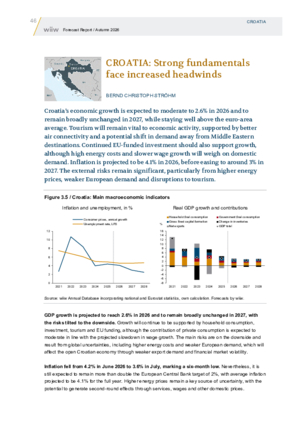
Croatia’s economic growth is expected to moderate to 2.6% in 2026 and to remain broadly unchanged in 2027, while staying well above the euro-area average. Tourism will remain vital to economic activity, supported by better air connectivity and a potential shift in demand away from Middle Eastern destinations. Continued EU-funded investment should also support growth, although high energy costs and slower wage growth will weigh on domestic demand. Inflation is projected to be 4.1% in 2026, before easing to around 3% in 2027. The external risks remain significant, particularly from higher energy prices, weaker European demand and disruptions to tourism.
CZECHIA: Riding the wave of high demand for electric vehicles
by Jakub Komárek
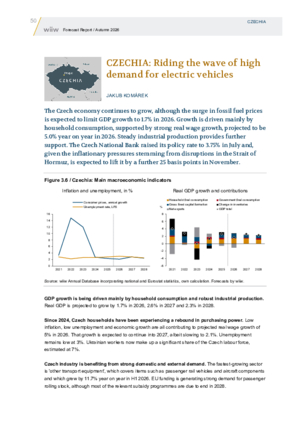
The Czech economy continues to grow, although the surge in fossil fuel prices is expected to limit GDP growth to 1.7% in 2026. Growth is driven mainly by household consumption, supported by strong real wage growth, projected to be 5.0% year on year in 2026. Steady industrial production provides further support. The Czech National Bank raised its policy rate to 3.75% in July and, given the inflationary pressures stemming from disruptions in the Strait of Hormuz, is expected to lift it by a further 25 basis points in November.
ESTONIA: Consumption-based recovery, investment on hold
by Marina Tverdostup
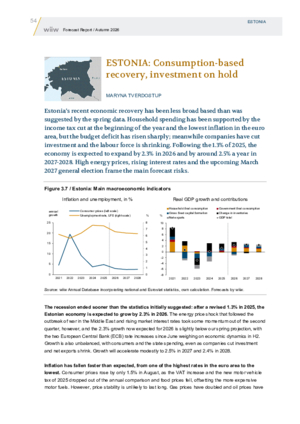
Estonia’s recent economic recovery has been less broad based than was suggested by the spring data. Household spending has been supported by the income tax cut at the beginning of the year and the lowest inflation in the euro area, but the budget deficit has risen sharply; meanwhile companies have cut investment and the labour force is shrinking. Following the 1.3% of 2025, the economy is expected to expand by 2.3% in 2026 and by around 2.5% a year in 2027-2028. High energy prices, rising interest rates and the upcoming March 2027 general election frame the main forecast risks.
HUNGARY: The beauty and challenges of a fresh start
by Sandor Richter
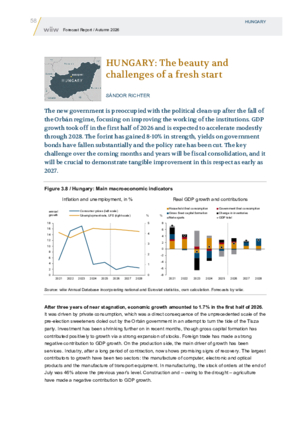
The new government is preoccupied with the political clean-up after the fall of the Orbán regime, focusing on improving the working of the institutions. GDP growth took off in the first half of 2026 and is expected to accelerate modestly through 2028. The forint has gained 8-10% in strength, yields on government bonds have fallen substantially and the policy rate has been cut. The key challenge over the coming months and years will be fiscal consolidation, and it will be crucial to demonstrate tangible improvement in this respect as early as 2027.
KAZAKHSTAN: Domestic demand set to strengthen
by Alexandra Bykova
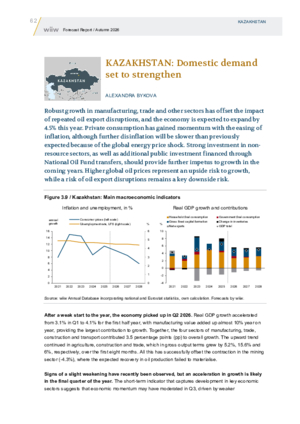
Robust growth in manufacturing, trade and other sectors has offset the impact of repeated oil export disruptions, and the economy is expected to expand by 4.5% this year. Private consumption has gained momentum with the easing of inflation, although further disinflation will be slower than previously expected because of the global energy price shock. Strong investment in non-resource sectors, as well as additional public investment financed through National Oil Fund transfers, should provide further impetus to growth in the coming years. Higher global oil prices represent an upside risk to growth, while a risk of oil export disruptions remains a key downside risk.
KOSOVO: Growth outlook remains favourable, despite rising inflation
by Isilda Mara
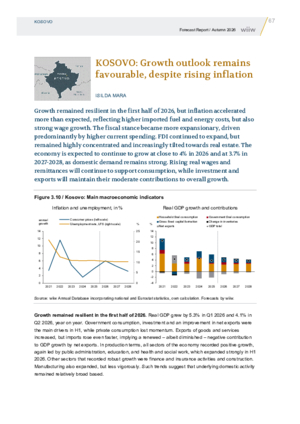
Growth remained resilient in the first half of 2026, but inflation accelerated more than expected, reflecting higher imported fuel and energy costs, but also strong wage growth. The fiscal stance became more expansionary, driven predominantly by higher current spending. FDI continued to expand, but remained highly concentrated and increasingly tilted towards real estate. The economy is expected to continue to grow at close to 4% in 2026 and at 3.7% in 2027-2028, as domestic demand remains strong. Rising real wages and remittances will continue to support consumption, while investment and exports will maintain their moderate contributions to overall growth.
LATVIA: Stronger growth comes with persistent fiscal and external deficits
by Emilė Petravičiūtė
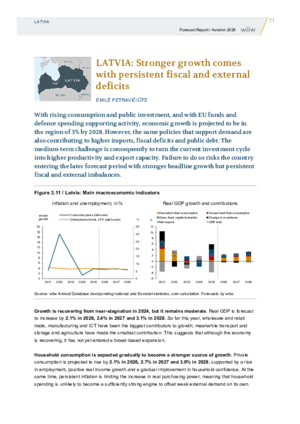
With rising consumption and public investment, and with EU funds and defence spending supporting activity, economic growth is projected to be in the region of 3% by 2028. However, the same policies that support demand are also contributing to higher imports, fiscal deficits and public debt. The medium-term challenge is consequently to turn the current investment cycle into higher productivity and export capacity. Failure to do so risks the country entering the later forecast period with stronger headline growth but persistent fiscal and external imbalances.
LITHUANIA: The current boost to growth is likely to be short-lived
by Emilė Petravičiūtė
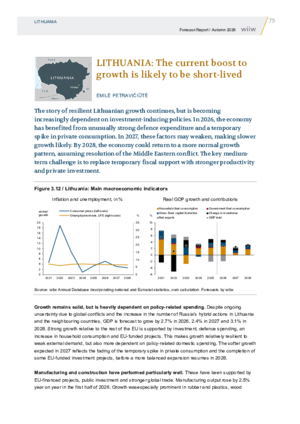
The story of resilient Lithuanian growth continues, but is becoming increasingly dependent on investment-inducing policies. In 2026, the economy has benefited from unusually strong defence expenditure and a temporary spike in private consumption. In 2027, these factors may weaken, making slower growth likely. By 2028, the economy could return to a more normal growth pattern, assuming resolution of the Middle Eastern conflict. The key medium-term challenge is to replace temporary fiscal support with stronger productivity and private investment.
free download
MOLDOVA: Growth slowing amid energy and fiscal pressures
by Gabor Hunya
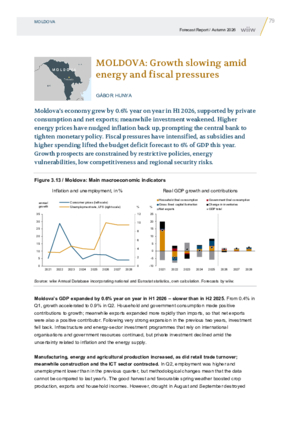
Moldova’s economy grew by 0.6% year on year in H1 2026, supported by private consumption and net exports; meanwhile investment weakened. Higher energy prices have nudged inflation back up, prompting the central bank to tighten monetary policy. Fiscal pressures have intensified, as subsidies and higher spending lifted the budget deficit forecast to 6% of GDP this year. Growth prospects are constrained by restrictive policies, energy vulnerabilities, low competitiveness and regional security risks.
MONTENEGRO: Moving forward, with many question marks
by Branimir Jovanović and Bernd Christoph Ströhm
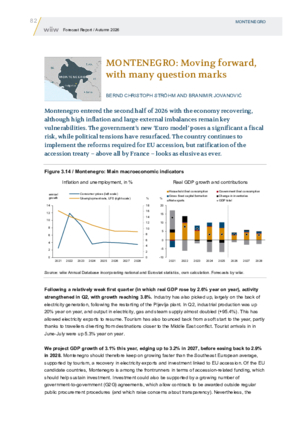
Montenegro entered the second half of 2026 with the economy recovering, although high inflation and large external imbalances remain key vulnerabilities. The government’s new ‘Euro model’ poses a significant a fiscal risk, while political tensions have resurfaced. The country continues to implement the reforms required for EU accession, but ratification of the accession treaty – above all by France – looks as elusive as ever.
NORTH MACEDONIA: Economic improvement something of a façade
by Branimir Jovanović
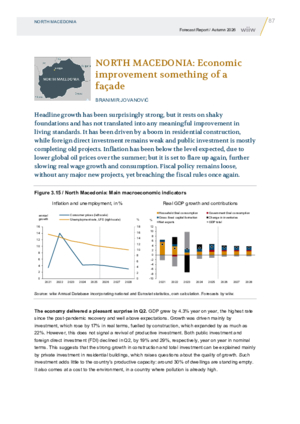
Headline growth has been surprisingly strong, but it rests on shaky foundations and has not translated into any meaningful improvement in living standards. It has been driven by a boom in residential construction, while foreign direct investment remains weak and public investment is mostly completing old projects. Inflation has been below the level expected, due to lower global oil prices over the summer; but it is set to flare up again, further slowing real wage growth and consumption. Fiscal policy remains loose, without any major new projects, yet breaching the fiscal rules once again.
POLAND: A small investment boom keeping GDP growth on a high trajectory
by Michał Możdżeń
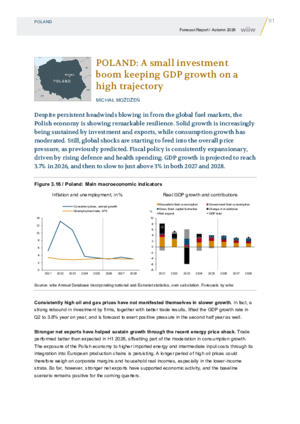
Despite persistent headwinds blowing in from the global fuel markets, the Polish economy is showing remarkable resilience. Solid growth is increasingly being sustained by investment and exports, while consumption growth has moderated. Still, global shocks are starting to feed into the overall price pressure, as previously predicted. Fiscal policy is consistently expansionary, driven by rising defence and health spending. GDP growth is projected to reach 3.7% in 2026, and then to slow to just above 3% in both 2027 and 2028.
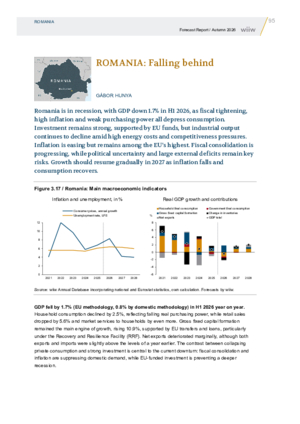
ROMANIA: Falling behind
by Gabor Hunya
Romania is in recession, with GDP down 1.7% in H1 2026, as fiscal tightening, high inflation and weak purchasing power all depress consumption. Investment remains strong, supported by EU funds, but industrial output continues to decline amid high energy costs and competitiveness pressures. Inflation is easing but remains among the EU’s highest. Fiscal consolidation is progressing, while political uncertainty and large external deficits remain key risks. Growth should resume gradually in 2027 as inflation falls and consumption recovers.
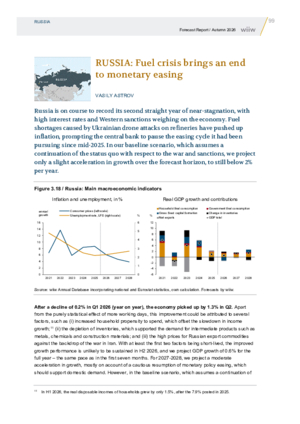
RUSSIA: Fuel crisis brings an end to monetary easing
by Vasily Astrov
Russia is on course to record its second straight year of near-stagnation, with high interest rates and Western sanctions weighing on the economy. Fuel shortages caused by Ukrainian drone attacks on refineries have pushed up inflation, prompting the central bank to pause the easing cycle it had been pursuing since mid-2025. In our baseline scenario, which assumes a continuation of the status quo with respect to the war and sanctions, we project only a slight acceleration in growth over the forecast horizon, to still below 2% per year.
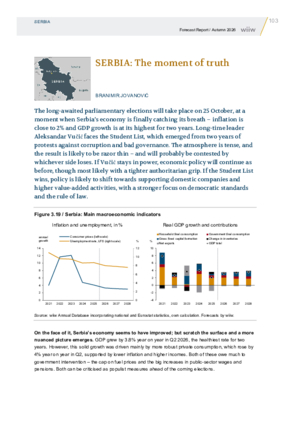
SERBIA: The moment of truth
by Branimir Jovanović
The long-awaited parliamentary elections will take place on 25 October, at a moment when Serbia’s economy is finally catching its breath – inflation is close to 2% and GDP growth is at its highest for two years. Long-time leader Aleksandar Vučić faces the Student List, which emerged from two years of protests against corruption and bad governance. The atmosphere is tense, and the result is likely to be razor thin – and will probably be contested by whichever side loses. If Vučić stays in power, economic policy will continue as before, though most likely with a tighter authoritarian grip. If the Student List wins, policy is likely to shift towards supporting domestic companies and higher value-added activities, with a stronger focus on democratic standards and the rule of law.
free download
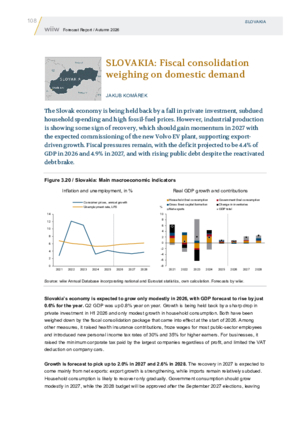
SLOVAKIA: Fiscal consolidation weighing on domestic demand
by Jakub Komárek
The Slovak economy is being held back by a fall in private investment, subdued household spending and high fossil-fuel prices. However, industrial production is showing some sign of recovery, which should gain momentum in 2027 with the expected commissioning of the new Volvo EV plant, supporting export-driven growth. Fiscal pressures remain, with the deficit projected to be 4.4% of GDP in 2026 and 4.9% in 2027, and with rising public debt despite the reactivated debt brake.
SLOVENIA: Sharp acceleration in growth unlikely to be sustained
by Niko Korpar
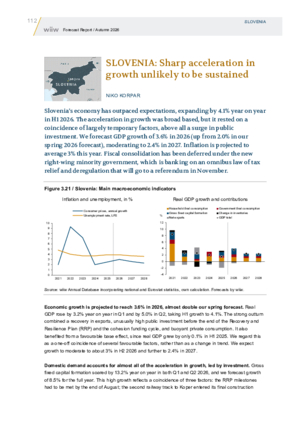
Slovenia’s economy has outpaced expectations, expanding by 4.1% year on year in H1 2026. The acceleration in growth was broad based, but it rested on a coincidence of largely temporary factors, above all a surge in public investment. We forecast GDP growth of 3.6% in 2026 (up from 2.0% in our spring 2026 forecast), moderating to 2.4% in 2027. Inflation is projected to average 3% this year. Fiscal consolidation has been deferred under the new right-wing minority government, which is banking on an omnibus law of tax relief and deregulation that will go to a referendum in November.
TURKEY: Growth moderates as financial-market turbulence raises risks
by Meryem Gökten
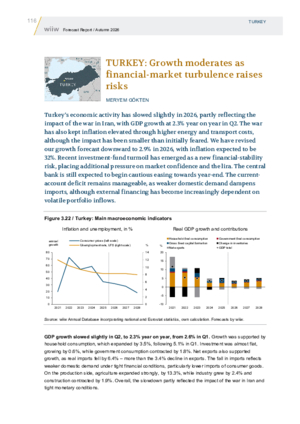
Turkey’s economic activity has slowed slightly in 2026, partly reflecting the impact of the war in Iran, with GDP growth at 2.3% year on year in Q2. The war has also kept inflation elevated through higher energy and transport costs, although the impact has been smaller than initially feared. We have revised our growth forecast downward to 2.9% in 2026, with inflation expected to be 32%. Recent investment-fund turmoil has emerged as a new financial-stability risk, placing additional pressure on market confidence and the lira. The central bank is still expected to begin cautious easing towards year-end. The current-account deficit remains manageable, as weaker domestic demand dampens imports, although external financing has become increasingly dependent on volatile portfolio inflows.
UKRAINE: Economic activity hit by Russian missile strikes
by Olga Pindyuk
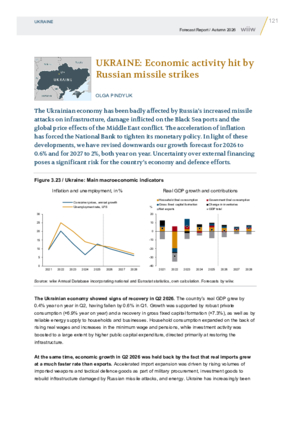
The Ukrainian economy has been badly affected by Russia’s increased missile attacks on infrastructure, damage inflicted on the Black Sea ports and the global price effects of the Middle East conflict. The acceleration of inflation has forced the National Bank to tighten its monetary policy. In light of these developments, we have revised downwards our growth forecast for 2026 to 0.6% and for 2027 to 2%, both year on year. Uncertainty over external financing poses a significant risk for the country’s economy and defence efforts.
Reference to wiiw databases: wiiw Annual Database, wiiw Monthly Database
Keywords: CESEE Central and Eastern Europe, economic forecast, Western Balkans, CIS, Ukraine, Russia, Turkey, EU, business cycle, economic sentiment, euro area, convergence, labour markets, unemployment, Russia-Ukraine war, commodity prices, inflation, price controls, trade disruptions, renewable energy, gas, electricity, monetary policy, fiscal policy
JEL classification: E20, E21, E22, E24, E32, E5, E62, F21, F31, H60, I18, J20, J30, O47, O52, O57, P24, P27, P33, P52
Countries covered: Albania, Austria, Belarus, Bosnia and Herzegovina, Bulgaria, Central and East Europe, CESEE, CIS, Croatia, Czechia, Estonia, Euro Area, European Union, Hungary, Kazakhstan, Kosovo, Latvia, Lithuania, Moldova, Montenegro, North Macedonia, Poland, Romania, Russia, Serbia, Slovakia, Slovenia, Southeast Europe, Turkey, Ukraine, US, Western Balkans
Research Areas: Macroeconomic Analysis and Policy, International Trade, Competitiveness and FDI
ISBN-13: ISBN 978-3-85209-084-9